



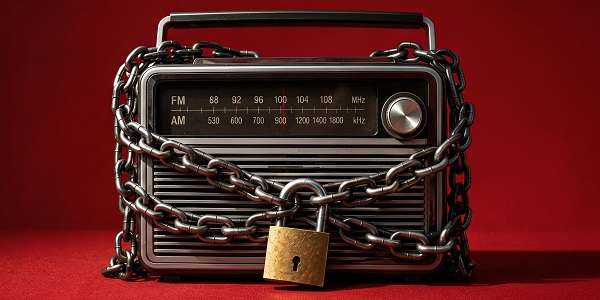
Ever wondered why FM radio stations in India don’t broadcast news? Or why your smartphone does not have an FM tuner app like in other countries? The answer is simple: government restrictions. The FM radio industry says these and other regulations are stifling their business, and the whole FM radio culture will wither on the vine if the government does not help soon.
The warning signs are already visible. Last month, HT Media announced it would surrender multiple FM radio licences in key markets, leading to five of its stations going off air on June 15.
 |
Radio has adapted to every disruption, It’s time our policies adapted too
The industry has urged the government to urgently carry out key reforms before more media companies close their FM shops, which are already facing challenges from digital audio platforms such as podcasts and streaming.
“The global shift towards on-demand audio is undeniable and well documented,” Nisha Narayanan, Director and COO of Red FM, told PTI. But the real question, she added, is whether the FM industry is being given a fair regulatory environment to “compete, innovate and monetise effectively” while making the transition.
For now, the industry’s four key demands are: allow private FM stations to broadcast news and current affairs, a privilege now given only to All India Radio; reduce GST on radio services from 18 per cent to 5 per cent; allow smartphone manufacturers to unlock FM receivers in devices; and implement a model under which radio companies would pay the government a fixed percentage of their actual earnings as licence fee, instead of paying charges linked to old auction prices.
For millions of Indians, FM radio has been a daily companion. During office commutes, in homes, in cars and in small towns where it remains one of the easiest ways to access entertainment and information.
Unlike internet-based audio platforms, radio works without a data connection and can reach listeners even during power cuts or network disruptions.
The government’s view, however, is that FM radio’s challenges cannot be looked at only through the lens of regulation. Union Minister of Information and Broadcasting Ashwini Vaishnaw told PTI that the sector is facing a broader technological transformation, similar to shifts seen in other industries. “It’s a major technological change which is happening and we are all aware of how … whether it is news industry whether it is entertainment … the entire shift towards digital has happened consistently over the last few years and this is a very big challenge for the FM industry,” he said.
According to Vaishnaw, such technological transitions inevitably reshape industries, drawing parallels with the decline of landlines after the spread of mobile phones and the shift from conventional vehicles to electric vehicles.
“Every such technological change brings changes in the industry structure,” he said.
On the industry’s demand to allow private FM stations to broadcast news, the minister said the government was examining the issue. “This is a demand from FM stations, FM service providers which have come to us. We are deliberating on it. It has multiple consequences because we have had a history which needs to be seen today and whatever we decide today has to be seen in the perspective that this industry has developed. Very soon we will be taking some decisions on it,” he said.
The industry argues that the problem goes beyond the rise of new-age platforms.
According to the Association of Radio Operators for India (AROI), radio is now the only segment of India’s media and entertainment industry that is shrinking.
While India’s overall media and entertainment sector grew 9 per cent to Rs 2.78 lakh crore in 2025, radio revenues declined 7 per cent to around Rs 2,300 crore, AROI estimates. The industry’s share of advertising spending has also fallen sharply over the past decade.
Industry estimates say radio’s share of the advertising market has declined from more than 3.4 per cent in 2015 to about 1.1 per cent in 2025. Private FM industry revenues in 2025 stood at around Rs 1,819 crore, still below 2020 levels despite a significant increase in the number of operational stations.
Radio’s difficulties cannot be viewed in isolation from the economic disruption caused by the pandemic and the uneven recovery that followed, Narayanan said.
“What the industry did not fully anticipate was the compound effect of several severe headwinds converging at once,” she added. Industry revenues, she said, fell nearly 50 per cent from pre-Covid levels and have yet to fully recover. At Red FM, government advertising volumes have declined by more than 30 per cent and revenues from that segment have fallen 27 per cent compared with pre-pandemic levels.
Radio City CEO Abe Thomas said both industry decisions and policy shortcomings contributed to the current situation. “The industry expanded aggressively, betting on a local advertising boom that grew slower than expected and the slow post-Covid recovery is when it really began to hurt,” he said.
“Simultaneously, policy bottlenecks — news restrictions, fragmented implementation, delayed reforms — constrained monetisation far more than comparable markets globally. Neither factor alone explains the current situation. It’s the combination that has been damaging,” he noted.
One of the industry’s biggest frustrations remains the prohibition on independent news broadcasts by private FM stations.
“The news ban has been one of FM’s most costly missed opportunities. News drives habitual listening, deepens community engagement and unlocks new revenue categories,” Thomas said.
Industry representatives point out that countries such as the United States, United Kingdom, Australia and the Philippines have successfully integrated news, talk programming, sports and local content into radio formats, helping maintain relevance even in the streaming era.
What could distinguish FM radio from music streaming services, they argue, is hyperlocal news, civic information, community discussions and city-specific content. However, the draft Telecommunications (Television, Radio and Associated Services) Rules, 2026 – made public for feedback on June 12 – continues the existing restriction on broadcasting news.
Broadcasters say that the current licensing structure is also among the biggest challenges facing the sector. “The FM radio industry has been plagued with skewed regulations,” an industry representative said, noting that license extension fees linked to historical auction prices impose a disproportionate burden on operators.
Broadcasters are seeking automatic licence extensions for existing operators rather than fresh auctions.
“The current batch of FM licences comes up for renewal in 2030 and that is not far away. With no clarity whatsoever on the renewal framework, pricing or TRAI recommendations, it’s extremely tough for operators to make long-term investments in people, technology or content without knowing the way forward,” Narayanan said.
Another longstanding demand concerns the activation of FM radio receivers on smartphones. Broadcasters say FM chips continue to exist in many devices but are often disabled, forcing listeners to consume radio through internet-based streaming instead of free over-the-air broadcasts.
“Activating them requires a software unlock, not a new component. This is not market intervention, it is a simple policy nudge,” Narayanan said.
Radio, in her view, remains a critical public service medium, particularly in a country where internet access remains uneven. “There are over 40 crore daily listeners across AIR, private FM and community radio in India. Radio provides last-mile access that no streaming platform can match. It works without internet, without subscriptions and on battery-powered devices during power cuts and emergencies,” she said.
Thomas agreed that FM radio continues to provide unique public value, particularly during crises. “FM remains the most resilient medium during disasters and network outages — in a country as large and diverse as India, that carries genuine public-interest value,” he said.
The debate over the future of radio has increasingly centred on competition from streaming services, podcasts and other digital audio platforms such as Spotify. “The shift to on-demand audio is real and irreversible. But FM still offers hyperlocal relevance, immediacy, mass reach and trust, especially during commutes, emergencies and regional moments,” Thomas said.
Radio operators also complain of a broader cost disadvantage compared with digital platforms. According to industry estimates, nearly 40 per cent of gross revenue is consumed by GST, licence fees, and spectrum-related charges.
Broadcasters say the sector paid nearly Rs 999 crore to the government in FY26, while the 18 per cent GST rate places radio at a disadvantage compared with other media segments taxed at 5 per cent.
Even so, industry leaders remain divided between concern and optimism about the future.
“The term ‘radio company’ itself is becoming obsolete. Consumers don’t distinguish between FM, podcasts, streaming or social audio; they simply consume content,” Thomas said.
He said future growth will come from building integrated ecosystems spanning broadcast, digital content, branded entertainment, live experiences and regional storytelling.
Without reforms, however, executives warn that the industry could shrink significantly before that transformation is complete.
“If nothing changes in the next two to three years… smaller operators will exit markets, deeply local stations will simply go dark and what survives will be leaner, more urban-focused and far less representative of the diversity of voices FM radio was meant to carry,” Narayanan said.
