


Close Menu
Timesbite

    Subscribe to Updates

    Get the latest creative news from FooBar about art, design and business.

    What's Hot

    PwC India Foundation strengthens climate Resilient Livelihoods for more than 400 Farming Households through Flood Recovery Initiatives

    March 17, 2026

    What We have Learned is a Handful; What We have not Learned is the Size of the World

    March 17, 2026

    State of Working India 2026: India's Young Workforce is Growing and Getting More Educated

    March 17, 2026
    Facebook X (Twitter) Instagram
    TimesbiteTimesbite
    Demo
    • Home
    • Latest
    • Business
    • Interviews
    • Lifestyle
    • Hervoice/TBTV
    • Sports
    Timesbite
    Home » State of Working India 2026: India's Young Workforce is Growing and Getting More Educated
    Business

    State of Working India 2026: India's Young Workforce is Growing and Getting More Educated

    EditorBy EditorMarch 17, 2026No Comments5 Mins Read
    Facebook Twitter LinkedIn Telegram Pinterest Tumblr Reddit Email
    Share
    Facebook Twitter LinkedIn Pinterest Email

    India has made substantial progress in expanding access to higher education for its young (15- to 29-year-olds) population, ensuring a movement out of agriculture into industry and services, and reduced gender and caste-based disparities, according to the ‘State of Working India 2026’ report. However, challenges remain and the extent to which the large, increasingly educated, and aspirational cohort is absorbed into the labour market will determine whether India’s demographic dividend translates into an economic dividend.
     

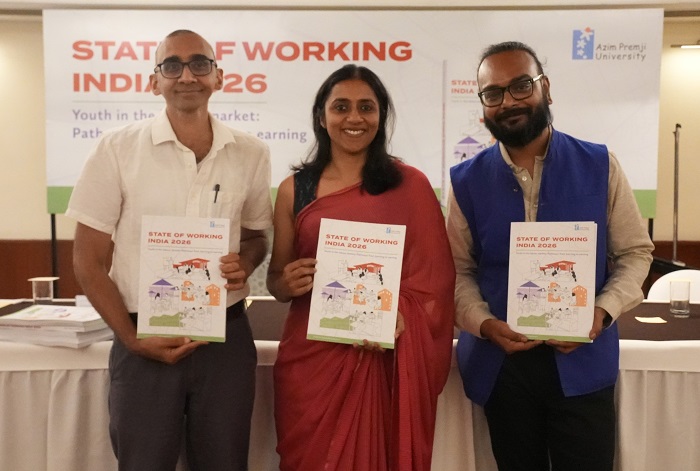
    L-R: Amit Basole, Rosa Abraham & Tamoghna Halder from Azim Premji University
     

    “More young people today are educated, informed, and ambitious than ever before. These are real achievements of which we can be proud,” noted Indu Prasad, President, Azim Premji Universities.
     

    The report draws on official databases going back four decades to see how youth participation in education and employment has changed, how well we have been able to use this demographic dividend, and the challenges and opportunities that arise in integrating them into the workforce.


    Rosa Abraham, lead author of the report and Associate Professor of Economics at Azim Premji University said, “The report traces the journey of a young worker – from education to job search and employment, and how this transition has evolved over the last forty years. We hope the report will lay out some of the foundational work that will contribute to a better understanding of the challenges in this transition and enable coordinated policymaking.”


    Key Findings

    • Demographic dividend nearing peak: India’s working-age population share will begin declining after 2030. The pace of job creation in the coming decades is critical to ensure that the demographic dividend translates into an economic one.

    • Rising educational attainment: Youth education levels have increased significantly over four decades, especially among women. India’s tertiary enrolment rate (28%) is comparable to countries with similar per capita incomes.

    • Drop in male tertiary enrolment: The share of young men in education fell from 38% in 2017 to 34% in late 2024, with a large share citing the need to support household incomes as reason for their withdrawal.

    • Expansion of higher education institutions: College availability increased from 29 per lakh youth (2010) to 45 (2021), mainly driven by private institutions. However, regional disparities remain large.

    • Teacher shortages: Faculty growth has not matched rising student numbers. Against AICTE norms of 15–20 students per teacher, private colleges average 28 and public colleges 47. Hiring and filling up vacancies remain crucial to ensure that learning outcomes are not compromised due to resource constraints.

    • Rapid expansion of vocational institutes: The number of Industrial Training Institutes (ITIs) has grown by nearly 300% since the 2010s, largely due to private providers. But, institutional quality, especially among private ITIs, has fallen.

    • Higher education has become increasingly democratised but financial barriers remain: Between 2007 and 2017, the share of students in tertiary education who belong to the poorest households increased from 8 percent to 15 percent.

    • Financial barriers in accessing professional courses: Students from richer households are far more likely to pursue engineering and medicine, as the cost of these degrees often exceeds the annual per capita expenditure of poorer households.

    • Difficult education-to-employment transition: Graduate unemployment among the 15- to 29-year-olds remains high – nearly 40% among the 15- to 25-year-olds, and 20% among the 25- to 29-year-olds; and, only a small share secure stable salaried jobs within a year of graduation.

    • Strong graduate wage premium: Graduates earn roughly twice as much as non-graduates at entry, and the earnings gap widens over their careers.

    • Stagnating male graduate earnings: Entry-level salaries for young male graduates have slowed in growth since 2011, while gender gaps in graduate earnings have narrowed.

    • Shift away from agriculture: Young workers are leaving agriculture faster than older cohorts and moving into manufacturing and services. Young women are increasingly employed in IT, automobile manufacturing, and business services.

    • Declining caste and gender occupational segregation: Younger cohorts are less concentrated in occupations traditionally linked to their caste or gender.

    • Migration as a labour market response: Youth migration helps balance regional disparities – poorer states and those with a younger population remain major labour sources, while richer states with a predominantly older population rely increasingly on migrant youth.
       

    For media queries contact:

    Rosa Abraham

    Email: rosa.abraham@apu.edu.in

    Ph: +91-9901957009
     

    Sony Shetty

    Email: sony.shetty@azimpremjifoundation.org

    Ph: +919820900036
     

    Sumit Jain

    Email: sumit.jain@k2communications.in

    Ph: +91 9886021715
     

    About Azim Premji University

    Azim Premji University, Bengaluru, was established under the Azim Premji University Act 2010 of the Government of Karnataka. Azim Premji University, Bhopal, was established under the provisions of Madhya Pradesh Niji Vishwa Vidyalaya (Sthapana Avam Sanchalan) Dwitiya Sanshodhan Adhiniyam, 2022. Azim Premji University in Ranchi is being established under the Azim Premji University Act, 2022, enacted by the Government of Jharkhand.
     

    Azim Premji Foundation, the sponsoring body, set up all three Universities as fully philanthropic entities, with a clear social purpose of contributing to the realisation of a just, equitable, humane, and sustainable society.

    Share. Facebook Twitter Pinterest LinkedIn Tumblr Email
    Editor
    • Website

    Related Posts

    PwC India Foundation strengthens climate Resilient Livelihoods for more than 400 Farming Households through Flood Recovery Initiatives

    March 17, 2026

    What We have Learned is a Handful; What We have not Learned is the Size of the World

    March 17, 2026

    India to Lead Global Dialogue at World Public Summit. India in New Delhi

    March 17, 2026

    Moscow Fashion Week Highlights Global Talent and Indian-Inspired Collections

    March 17, 2026

    MATTER Integrates Iontra's Battery Intelligence as one of the Core Layers of Its AI-Defined Vehicle (AIDV) Platform, Advancing AI-Governed Systems

    March 17, 2026

    Nebius Expands into Asia-Pacific Region to Support Rapid Global Growth

    March 17, 2026
    Leave A Reply Cancel Reply

    Top Posts

    OPPO Find X8 Series Goes on Sale: Price, Launch Offers, Specs and More

    December 4, 2024

    Top 5 Businessmen in India: Titans of Industry

    September 24, 2024

    Baba Siddique Assassinated: Mumbai Ex-Minister Gunned Down on Dussehra Night

    October 12, 2024

    Top 5 Online Businesses to Watch for in 2025

    September 23, 2024
    Don't Miss
    Business

    PwC India Foundation strengthens climate Resilient Livelihoods for more than 400 Farming Households through Flood Recovery Initiatives

    By EditorMarch 17, 2026

    PwC India Foundation (PwCIF) is expanding its commitment to integrated flood recovery interventions by supporting…

    What We have Learned is a Handful; What We have not Learned is the Size of the World

    March 17, 2026

    State of Working India 2026: India's Young Workforce is Growing and Getting More Educated

    March 17, 2026

    Moscow Fashion Week Highlights Global Talent and Indian-Inspired Collections

    March 17, 2026
    Editors Picks

    What is a Credit Score? The beginner guide for the first-time Indian borrower

    October 26, 2024

    Blending Traditional Classrooms with Augmented Reality: A Transformative Approach to Learning

    October 24, 2024

    Sony India Establishes ‘Cinema is Coming Home’ Concept for BRAVIA Televisions, Stamped by Acclaimed Filmmaker Mr. S.S. Rajamouli’s Cinematic Vision

    October 18, 2024

    Third Wave Coffee marks 8 years of creative journeys fueled by coffee with the ‘Inspiring Indian Crea8ors’ campaign

    October 18, 2024
    Latest Posts

    Subscribe to News

    Get the latest sports news from NewsSite about world, sports and politics.

    Advertisement
    Don't Miss
    Business

    PwC India Foundation strengthens climate Resilient Livelihoods for more than 400 Farming Households through Flood Recovery Initiatives

    By EditorMarch 17, 2026

    PwC India Foundation (PwCIF) is expanding its commitment to integrated flood recovery interventions by supporting…

    What We have Learned is a Handful; What We have not Learned is the Size of the World

    March 17, 2026

    State of Working India 2026: India's Young Workforce is Growing and Getting More Educated

    March 17, 2026

    Moscow Fashion Week Highlights Global Talent and Indian-Inspired Collections

    March 17, 2026
    Our Picks

    PwC India Foundation strengthens climate Resilient Livelihoods for more than 400 Farming Households through Flood Recovery Initiatives

    March 17, 2026

    What We have Learned is a Handful; What We have not Learned is the Size of the World

    March 17, 2026

    State of Working India 2026: India's Young Workforce is Growing and Getting More Educated

    March 17, 2026

    Moscow Fashion Week Highlights Global Talent and Indian-Inspired Collections

    March 17, 2026
    About Us
    About Us

    Welcome to TimesBite, your premier destination for up-to-the-minute news and in-depth analysis across a wide array of topics. Founded with the mission to deliver accurate, reliable, and engaging news coverage, TimesBite is dedicated to keeping our readers informed about the events that shape our world. We're accepting new partnerships right now.

    Email Us: editor@timesbite.com

    Editor’s Pick

    PwC India Foundation strengthens climate Resilient Livelihoods for more than 400 Farming Households through Flood Recovery Initiatives

    March 17, 2026

    What We have Learned is a Handful; What We have not Learned is the Size of the World

    March 17, 2026

    State of Working India 2026: India's Young Workforce is Growing and Getting More Educated

    March 17, 2026
    Most Popular

    OPPO Find X8 Series Goes on Sale: Price, Launch Offers, Specs and More

    December 4, 2024

    Top 5 Businessmen in India: Titans of Industry

    September 24, 2024

    Baba Siddique Assassinated: Mumbai Ex-Minister Gunned Down on Dussehra Night

    October 12, 2024
    Facebook X (Twitter) Instagram LinkedIn
    • About US
    • Disclaimer/ Privacy Policy
    • Contact Us
    © 2026 Timesbite. All rights reserved.

    Type above and press Enter to search. Press Esc to cancel.