




Catalyst Training Services (Catalyst), a Bengaluru-based sales-performance consultancy, has won Silver at the 2026 Brandon Hall Group HCM Excellence Awards® in the Best Sales Training Program for Extended Enterprise category for Dealer Conversion Breakthrough, a dealer sales transformation programme conceptualised, designed and delivered by Catalyst for TVS Motor Company Limited.
 |
Madhusudhan P, Founder and CEO, Catalyst Training Services
The award was presented jointly to TVS Motor Company Limited and Catalyst Training Services. Importantly, the recognition sits in Brandon Hall Group’s Sales Performance program area, placing the programme in the distinctly business-facing territory of sales execution and measurable performance, rather than recognising learning activity alone.
A modern sales problem: Information overload on both sides of the counter
The recognition validates an idea at the heart of Catalyst’s work, said Madhusudhan P, Founder Catalyst Training Services Pvt Ltd “The modern sales problem is no longer an information deficit. It is an information-overload problem, on both sides of the counter.”
Today’s customer often arrives at a showroom having already consumed product information through social media, videos, reviews, comparison platforms, brand communication, influencers and personal research. The challenge is increasingly not access to information. It is cutting through the clutter and helping the customer see what really matters.
The salesperson faces the other side of the same problem. Modern organisations have sophisticated sales processes, SOPs, product training, competitive information, CRM practices, customer-experience standards and selling frameworks. A frontline salesperson can therefore have hundreds of things to know, remember and do during a customer interaction.
All of them may be important. But all of them cannot be equally important at the moment the customer is making a decision.
Catalyst’s work focuses on identifying the vital few among the important many, the small number of observable sales behaviours that can disproportionately influence the customer’s decision, and engineering them to become simple, coachable and repeatable at the frontline.
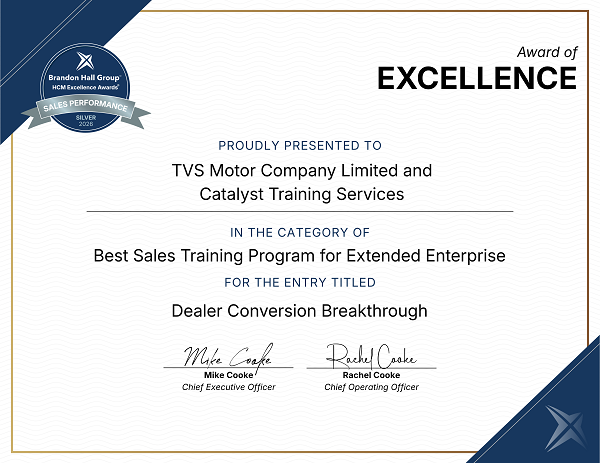 |
Catalyst wins 2026 Brandon Hall Group Silver with TVS Motor for Dealer Conversion Breakthrough, a dealer sales transformation programme
The Challenge: Product value customers could not always see
Dealer Conversion Breakthrough originated from a sales-performance challenge in the commuter-motorcycle segment across an extended dealer network.
Catalyst’s competitive research uncovered an important distinction: the products did not necessarily suffer from a product-value disadvantage. They suffered from a product-value visibility disadvantage.
Customer-relevant advantages already existed. But unless salespeople deliberately mentioned, demonstrated and compared those advantages, customers could easily fail to perceive meaningful differentiation.
The answer, therefore, was not another information-heavy product-training programme. It was to make the value already present in the product visible to the customer.
From product knowledge to persuasive, observable behaviour
Rather than attempting to teach every feature in a product brochure, Catalyst identified a limited number of customer-relevant competitive differentiators and translated them into a simple sales-execution methodology built around observable demonstration behaviours.
Participants learnt not merely to say what a product offered, but to physically demonstrate relevant advantages and make meaningful competitive differences visible to customers.
The programme was deliberately designed to reduce dependence on memory. Product differentiators were arranged around the physical geography of the motorcycle so that movement around the product itself helped cue what needed to be demonstrated.
Performance could then be observed and measured using simple behavioural criteria rather than relying solely on knowledge tests, participant reactions or subjective facilitator judgement. In other words, the behaviours were designed to be visible enough to learn, coach, measure and replicate.
From months to minutes: Below 25% to above 80% proficiency in 30–40 minutes
The programme reached approximately 650 participants through 45 workshops across Uttar Pradesh, Haryana and Rajasthan.
In frontline sales, building demonstration proficiency is typically treated as a journey measured in weeks or months, involving product training, practice, role plays, field exposure, shadowing and repeated coaching.
Catalyst approached the problem differently. Instead of asking how much more the salesperson needed to learn, we asked how much less the salesperson needed to remember.
During workshops, a randomly selected participant would first conduct an unassisted product demonstration. Initial demonstration proficiency typically scored below 25%.
After observing the methodology, using the behavioural coaching tool and repeating the demonstration, the same participant typically progressed to above 80% proficiency within approximately 30-40 minutes.
Not months. Minutes.
Importantly, participants themselves used the same criteria to evaluate the demonstrations. The improvement therefore became visible not only to the facilitator, but to the entire room.
When learning travelled into the field
Evidence of field application began appearing soon after the intervention. Fifteen participating dealerships in Rajasthan subsequently reported sales improvements ranging from 5% to 300% over their respective previous monthly averages.
These figures were dealer-reported rather than independently audited and represented dealerships beginning from substantially different sales volumes. They are therefore not presented as an average or as a guaranteed programme outcome.
But another development became particularly significant: the methodology began travelling without Catalyst.
Field managers who had experienced the programme independently transferred the approach to dealership salespeople in other territories. Subsequent field reports documented improvements in sales, demonstration quality, market share and reduced dependence on discounting.
The programme was no longer simply demonstrating that people could learn differently. It was demonstrating that the behaviour could be transferred, observed, coached and replicated without continuous dependence on the original facilitator.
Commenting on the recognition, Madhusudhan P., Founder, Catalyst, said, “Today’s customer has often consumed enormous amounts of information before walking into a showroom. He doesn’t necessarily need another person giving him more information. He needs someone who can cut through the clutter and help him see what really matters.” He added, “The salesperson faces the other side of the same problem. Organisations have invested heavily in product knowledge, processes, SOPs and training, leaving the salesperson with hundreds of things to remember and do. They’re all important. The challenge is identifying the vital few among the important many — the behaviours that disproportionately influence the customer’s decision.”
From training people to engineering sales execution
The programme also demonstrated a principle about frontline capability: knowledge can be distributed, but consistent execution has to be engineered.
By reducing cognitive load and translating sales execution into observable behaviours, Catalyst’s approach is designed to reduce dependence on individual memory, exceptional salespeople or continuous facilitator intervention.
The objective is not to replace an organisation’s existing sales processes, SOPs or training infrastructure. It is to identify and engineer the vital few behaviours within that environment that disproportionately influence execution at the moment of sale. “Behaviours are upstream. Results are downstream.”
When organisations can identify, observe and engineer the behaviours that matter most, frontline performance becomes less dependent on individual brilliance — and more capable of being replicated at scale.
Why this recognition matters
Brandon Hall Group’s HCM Excellence Awards are evaluated by a panel of independent senior industry experts, practitioners, analysts and executive leadership. Entries are assessed against defined criteria that examine the design and use of the programme, innovation, functionality and measurable benefits and results. Award levels are determined by points earned—not by a ranking curve.
Catalyst’s Dealer Conversion Breakthrough received Silver in the Sales Performance program area, in the Best Sales Training Program for Extended Enterprise category.
The significance therefore goes beyond winning a training award. The recognition provides independent validation that a frontline sales intervention developed in India could demonstrate what matters most: a clearly defined business need, an engineered solution, scalable execution across a dealer network, and measurable business impact.
For Catalyst, this validates a larger proposition: sales transformation does not necessarily come from giving frontline salespeople more to learn. It can come from identifying the vital few behaviours that disproportionately influence the sale, making those behaviours observable, coachable and repeatable and engineering them to work at scale.
Catalyst’s broader philosophy
Sales Success, Engineered.™
Sales Systems That Deliver White-Collar Effectiveness at Blue-Collar Scale.
About Catalyst
Catalyst Training Services (Catalyst) is a Bengaluru-based sales-performance consultancy focused on making frontline selling visible, coachable and repeatable.
Founded in 2002, Catalyst has delivered sales-performance interventions in five countries to more than 37,000 sales professionals representing 14 countries, primarily across the automotive and technology sectors.
Catalyst works with organisations to identify the vital few among the important many observable sales behaviours that disproportionately influence customer decisions and engineer those behaviours for consistent frontline execution.
Its approach is built around a simple premise: the modern sales problem is no longer an information deficit. It is an information-overload problem on both sides of the counter.
For more information, please visit website catalystnow.in.
